
From E20 to E100: The Real Battle Is Infrastructure

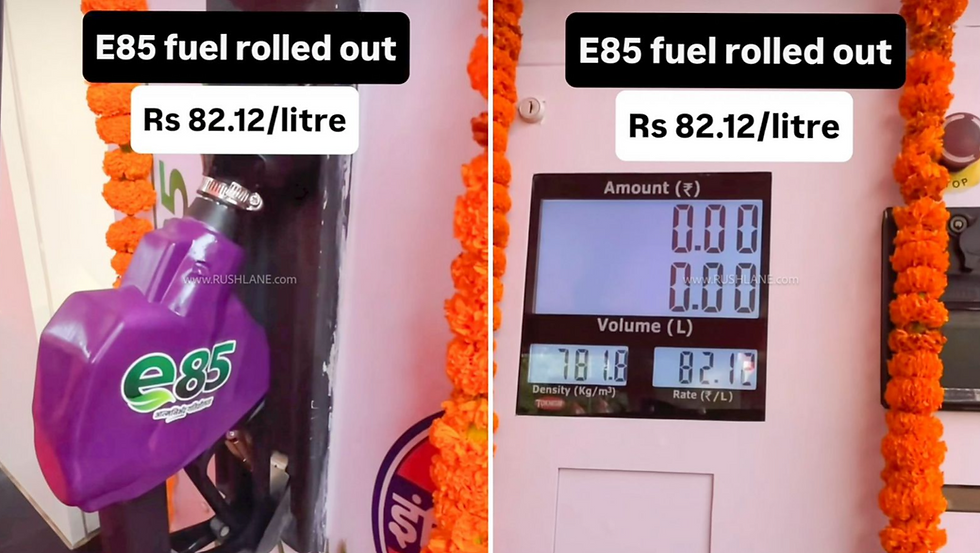
India’s ethanol journey has moved faster than many expected. After successfully achieving nationwide E20 fuel rollout ahead of schedule, the government is now preparing the next phase — introducing E85 and E100 fuels for flex-fuel vehicles. Draft amendments to the Central Motor Vehicles Rules now propose formal recognition of higher ethanol blends, signalling a major shift in India’s fuel strategy.
But while the policy ambition is bold, the real question is whether India’s ethanol ecosystem is ready for it.
The transition from E20 to E85 or E100 is not simply about blending more ethanol into petrol. It requires a complete transformation of fuel production, storage infrastructure, distribution systems, vehicle technology, and agricultural supply chains.
Why India Is Pushing E85 and E100
India imports nearly 85–90% of its crude oil requirement, making the country vulnerable to global price shocks and geopolitical disruptions. Higher ethanol blending is being seen as a strategic tool for:
Reducing crude oil imports
Improving energy security
Supporting farmers through alternative crop demand
Lowering vehicular emissions
Expanding the biofuel economy
The government’s new proposal aims to encourage flex-fuel vehicles capable of operating on E85 (85% ethanol blend) and E100 (near-pure ethanol fuel).
Countries like Brazil have already demonstrated that large-scale ethanol fuel systems are technically possible. India now wants to build its own version of that ecosystem.

India’s Ethanol Production: Strong Growth, But New Pressure Ahead
India’s ethanol production capacity has expanded rapidly over the last few years, supported by government incentives, grain diversification policies, and blending targets.
Current installed ethanol production capacity is estimated at around 20–21 billion litres annually, while present E20 demand is roughly 10–12 billion litres. On paper, this appears sufficient for the current blending programme.
However, higher ethanol blends dramatically increase fuel demand.
Industry estimates suggest that:
E85 adoption could require 35–45 billion litres annually
E100 would push demand even further
India may need an additional 15–25 billion litres of dependable ethanol production capacity in the coming years
This creates pressure on three critical areas:
1. Feedstock Availability
India still relies heavily on sugarcane molasses for ethanol production. But sugar-based ethanol is seasonal and vulnerable to fluctuations in sugar production cycles.
Future expansion will increasingly depend on:
Maize-based ethanol
Surplus rice
Agricultural residues
Second-generation (2G) ethanol technologies
Experts believe large-scale 2G ethanol projects will become essential if India wants sustainable E85 or E100 adoption.
2. Food vs Fuel Debate
Higher ethanol demand could intensify concerns over:
Water-intensive crops
Land use pressure
Food grain diversion
Agricultural sustainability
Sugarcane and paddy already consume significant water resources in India. Scaling ethanol production without diversified feedstocks may create long-term sustainability concerns.
3. Massive Investment Requirement
Industry experts estimate that India may require investments worth ₹1.5–2 lakh crore in new ethanol capacity, especially for advanced biofuel and 2G ethanol infrastructure.
The Bigger Challenge: Storage and Fuel Logistics
While production capacity receives most attention, storage and logistics may become the biggest operational bottleneck.
Unlike petrol, ethanol is:
Hygroscopic (absorbs water easily)
More corrosive
Sensitive to contamination
Difficult to store using conventional fuel infrastructure
This creates major challenges across the fuel supply chain.
Existing Fuel Infrastructure Cannot Fully Support E85/E100
India’s E20 rollout was relatively easier because the existing petroleum infrastructure could still handle low ethanol blends with limited modifications.
But E85 and E100 are different.
Higher ethanol concentrations require:
Corrosion-resistant pipelines
Specialised storage tanks
Ethanol-compatible dispensing systems
Dedicated transport logistics
Separate blending terminals
Industry experts warn that most of India’s fuel stations are not designed for high-ethanol fuels. Retrofitting fuel stations alone may require investments exceeding ₹2,000 crore nationwide.
Oil Marketing Companies (OMCs) such as Indian Oil, BPCL, and HPCL are expected to invest heavily in:
Blending terminals
Dedicated ethanol storage
Dry logistics infrastructure
Ethanol handling systems
Some estimates place logistics infrastructure investment requirements at over ₹5,000 crore.
Vehicle Readiness Remains a Key Question
Fuel infrastructure is only one side of the equation. Vehicle compatibility is equally important.
Most vehicles currently on Indian roads are designed for E20 compatibility, not E85 or E100.
Higher ethanol blends require:
Modified engines
Special fuel systems
Ethanol-resistant materials
Advanced engine calibration
Flex-fuel vehicle technology already exists globally, especially in Brazil. However, India still needs:
Local certification standards
OEM adoption
Testing frameworks
Large-scale manufacturing readiness
The government’s draft notification is expected to create a formal regulatory pathway for such vehicles.
Public Concerns Around Higher Ethanol Blends
The proposed shift toward E85 and E100 has also triggered public debate.
Across online automotive communities, many users have raised concerns regarding:
Reduced mileage
Engine compatibility
Higher maintenance costs
Corrosion risks
Misfuelling issues
Lack of consumer awareness
Several discussions on Indian automobile forums and Reddit communities highlight fears that a rapid transition could affect older vehicles not designed for high ethanol blends.
At the same time, supporters argue that:
E20 will continue as the mainstream fuel
E85/E100 adoption will be gradual
Flex-fuel vehicles will evolve in parallel
Energy security benefits justify long-term investment
India’s Ethanol Future Will Likely Be Multi-Fuel
Industry experts increasingly believe India will not move directly from E20 to E100 overnight.
Instead, the country is likely to develop a multi-fuel ecosystem where:
E20 remains the mass-market fuel
Mid-level blends like E30 or E50 gradually expand
E85/E100 serve flex-fuel vehicles in selected markets
This phased approach may help avoid a “chicken-and-egg” problem where automakers wait for fuel infrastructure while fuel retailers wait for compatible vehicles.
Conclusion
India’s E20 programme proved that policy-driven ethanol blending can scale rapidly. But the move toward E85 and E100 is a much larger industrial transformation.
The challenge is no longer just about producing ethanol. It is about building an entirely new fuel ecosystem that includes:
Sustainable feedstock supply
Advanced ethanol production
Corrosion-resistant storage systems
Nationwide logistics infrastructure
Flex-fuel vehicle readiness
Consumer awareness and adoption
India’s success will depend on how effectively policymakers, oil companies, automakers, ethanol producers, and infrastructure developers work together over the next decade.
The ambition is clear. The execution will determine whether E85 and E100 become India’s energy breakthrough — or a logistical challenge too large to scale efficiently.
-Sandeep Maurya
(Ethanol Plant Consultant )


Comments